21 July 2026
The DSA Interviews Have Started. A Singapore English Principal on the Signal That Makes a Panel Lean In
With interview windows opening now, most families spend the last days polishing answers. Grace Tan — who runs an 'Ace Your DSA Interview' workshop at her English enrichment centre — points to something you can't rehearse into a script: warmth. Here's what she means, and how it fits what other Singapore coaches have told us.
The shortlist emails have been landing for weeks now, and the DSA interview windows are open. If your child's invitation has arrived, the application is long behind you and there is a date on the calendar — often only days away. The instinct, almost universally, is to spend those days sharpening the answers.
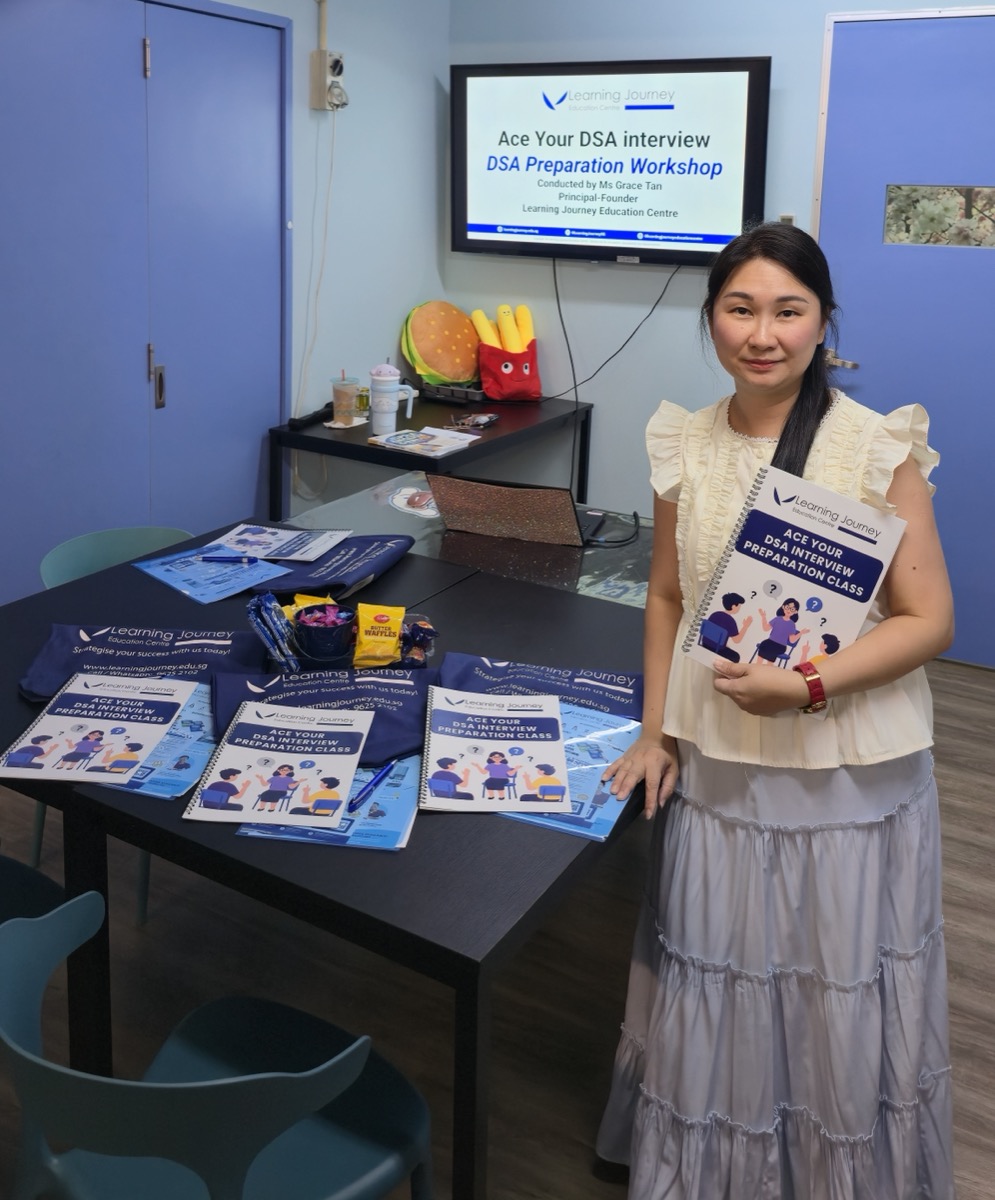
We keep returning to interview coaches at this point in the year because they keep saying the same uncomfortable thing: the sharpening is where it goes wrong. We put our three standard questions to Ms Grace Tan, Principal & Founder of Learning Journey Education Centre — an English enrichment centre that runs an "Ace Your DSA Interview" preparation workshop for P6 families. Her answers line up with what other coaches have told us on the core mistake — and then add a signal the others didn't name.
The mistake, again — but named from the language teacher's side
Ask any interview coach what parents get most wrong and you get a version of the same answer. Here is Grace's:
"The most common mistake that parents make is trying to get their child to adopt 'model answers' that are suggested by an adult, instead of authentic responses from a 12 year old. They should help their child 'find his/her voice' by sharing & articulating their talent area passionately with the interviewers."
— Ms Grace Tan, Principal & Founder, Learning Journey Education Centre
It is worth noticing where she is standing when she says it. Grace's centre teaches English and composition — her whole craft is helping children articulate. And even from that chair, the advice isn't "give them better lines." It's the opposite: an adult's "model answer" in a 12-year-old's mouth is the problem, not the fix.
That matches what three other coaches told us independently earlier this month — that the memorised, over-polished answer is the single biggest mistake a family can make. Four practitioners, four different specialisms, one warning. If there is a settled consensus anywhere in DSA preparation, it is this: a rehearsed 12-year-old sounds like a rehearsed 12-year-old, and panels can hear it.
The phrase Grace adds to the pile is find his/her voice. Not find the right answer — find the voice. For a child, that is the difference between reciting a script an adult wrote and actually saying something they mean.
The part the others didn't name: warmth
Here is where Grace's answer diverges from the coaches we've quoted before. Asked what specific signal makes an interviewer lean in and remember a child, most coaches talk about composure, thinking on your feet, handling the unexpected question. Grace talks about something warmer:
"When a child is genuinely passionate and shares their responses earnestly with a big smile, plus meaningful personal experiences related to the questions asked. These leave deep impressions on the interviewers!"
— Ms Grace Tan, Principal & Founder, Learning Journey Education Centre
A big smile. It sounds almost too simple to write down. But sit with how rarely it appears on anyone's interview-prep checklist. Families drill content, anticipate questions, rehearse composure — and almost no one thinks to protect the child's warmth, the very thing Grace says leaves the deepest impression.
There's a reason it gets squeezed out. The more anxious a household becomes about performance, the more the child's face closes down. A 12-year-old worried about getting the answer "right" does not beam. So warmth isn't a separate skill to add on top of preparation — it is usually the first casualty of over-preparation. Which loops straight back to her first point: the more you script, the less the real child shows up in the room.
Notice, too, the second half of her answer: meaningful personal experiences related to the questions asked. This is the concrete raw material of warmth. A child who can reach for a real moment — a competition that went wrong, why they first fell for their sport, the teacher who changed things — has something to be genuinely animated about. You cannot fake-smile your way through a memorised paragraph. You can light up telling a story that actually happened to you.
What a family can do at home — free, and this week
Not everyone books a workshop, and Grace's at-home advice costs nothing but a phone:
"Practice articulating your responses by recording it on your mobile phone video. That way you can playback to help you review your interview responses. Parents can also play the role of interviewers and role play the commonly asked interview questions with their child."
— Ms Grace Tan, Principal & Founder, Learning Journey Education Centre
Two drills, and they do different jobs.
The recording is the one families skip, and it's the more powerful of the two. A child cannot see their own closed-off face or hear their own flat, recited voice — but they can watch it on a replay, and they'll notice instantly. It turns "sit up and smile," which a parent can nag about forever, into something the child spots for themselves. Used gently, it builds the self-awareness that a coach would otherwise charge for. (Used harshly, as a highlight reel of everything wrong, it will do the reverse — the point is the child reviewing themselves, not the parent grading them.)
The role-play does the other half. It rehearses the conditions — a question asked out loud by someone playing a stranger, the need to answer in the moment — rather than the content. That's the same instinct a debate coach gave us for calming nerves: simulate the situation, don't just polish the material. Grace's version is simply the kitchen-table one any parent can run tonight.
Put the two together and you have a complete loop that needs no coach and no fee: role-play a real question, film the answer, watch it back together, notice one thing, go again. Fifteen minutes. It trains exactly what the panel is reading for — a child who sounds like themselves — and none of what it isn't.
Where you actually are in the calendar
It helps to know how much clock you're working with, because it changes what's worth doing.
There is no national timetable for this stage. MOE does not publish a central schedule for school selection — each school sets and sends its own interview, trial and audition dates, which is why one family's date lands this week and another's in three. What MOE does commit to is the end point: your child will receive the DSA-Sec application outcome by Friday, 28 August 2026.
So the window you're in now is short, and it is the last part of this process you have any influence over. That is precisely why the temptation is to cram — another mock, another polished paragraph. Everything Grace describes points the other way. The days are better spent protecting the child's voice and warmth than adding material that, learned this week, will be the least secure thing they own on the day.
What this means for you
- Stop feeding them lines. An adult's "model answer" is the single mistake four separate coaches have now flagged to us. Help the child find their voice, not borrow yours.
- Protect the warmth. Genuine passion and a real smile are, in Grace's experience, what leave the deepest impression — and they are the first thing anxiety kills. Guarding your child's ease in the room is preparation, not a distraction from it.
- Stock up on real stories, not polished paragraphs. "Meaningful personal experiences" are what a child can light up about. Help them find two or three true moments they'd be happy to talk about, and let the wording come out fresh each time.
- Run the phone drill this week. Role-play a question, film the answer, watch it back together, fix one thing, repeat. Free, fifteen minutes, and it builds the self-awareness a child can't get any other way.
- Don't add new material. With the outcome due by 28 August and the date close, a piece learned this week is a liability, not an asset.
If your child's interview is coming, our DSA interview prep guide walks through what to expect and how these panels are actually run, and the seven questions Singapore schools tend to ask gives you material to role-play tonight. For the wider picture, what three interview coaches say panels are really reading and, if your date is close, the final-stretch advice from drama, dance and debate coaches go deeper. New to all of this? Start with What is DSA-Sec? or check which schools offer your child's talent with the DSA-Sec School Finder.
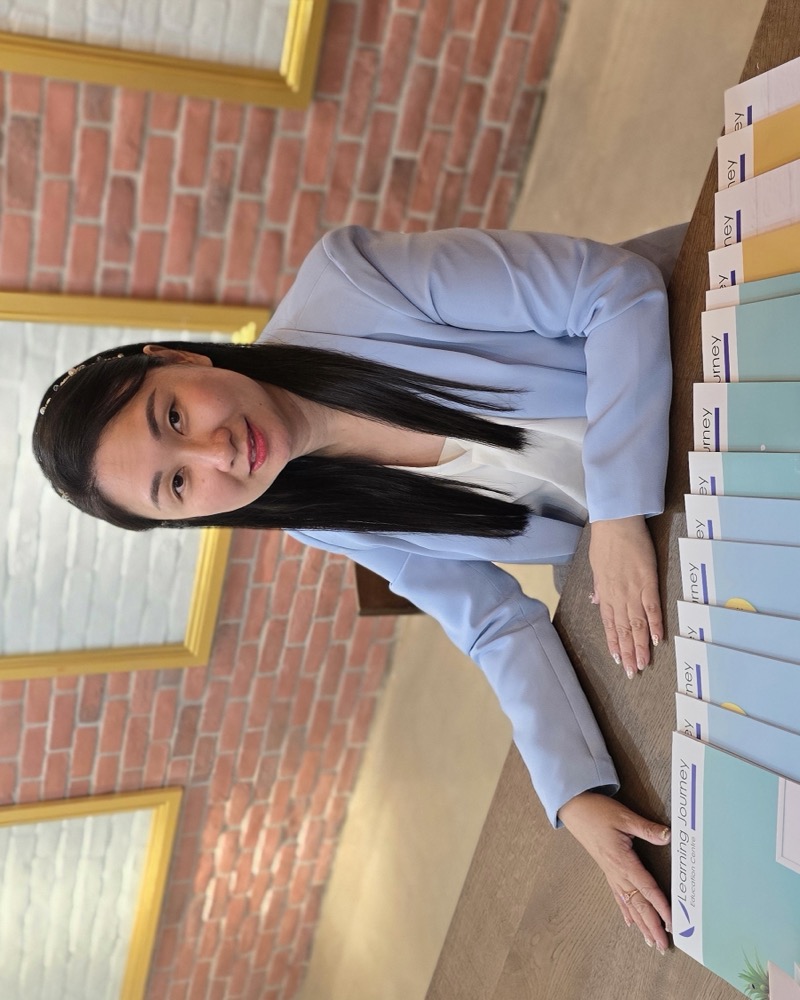
With thanks to Ms Grace Tan (Principal & Founder, Learning Journey Education Centre) for sharing her perspective. Quotes are reproduced as sent, edited only for typographical errors. Coaches' observations reflect their own experience and are not official MOE criteria. The 28 August 2026 outcome date is per MOE's published DSA-Sec information; MOE does not publish a central schedule for school selection activities. DSALink is an independent resource and is not affiliated with MOE.
Free · No spam
Get DSALink updates
New DSA guides on schools, interview prep and coaches, sent to your inbox from time to time. No spam.
Follow us
Daily DSA tips, school news, and quick guides across: