28 August 2026
Multiple Offers, One Offer, or None: The Strategic Play for Every DSA Results-Day Outcome
Schools notify by 28 August, and whatever lands in your inbox — a Confirmed Offer, two of them, a Wait List, or an Unsuccessful — the smart move is rarely the obvious one. A scenario-by-scenario DSA-Sec playbook: how to choose between two Confirmed Offers, why a lukewarm offer plus a wait list at the school you wanted is a ranking problem and not a gamble, whether a DSA offer is binding, whether you can decline one, and what actually happens if nothing comes through. Rules are MOE-sourced; the part about steadying your child comes from child psychologists — because that is a strategy too.

By Friday, 28 August 2026, the schools will have told you. Not MOE, not a portal: each school, on its own, letting you know whether your child has a Confirmed Offer, a place on the Wait List, or an Unsuccessful outcome. Some schools send word earlier in the week; the 28th is the outside edge.
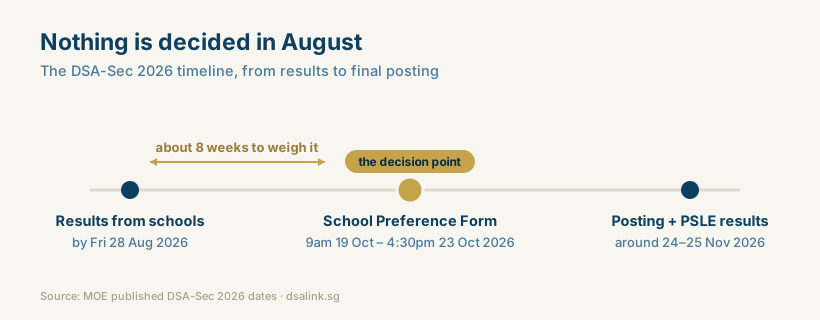
Results don't all land at once — they trickle in across the window, and one school going quiet while another has written is normal, not a bad sign. Whatever the outcome, the hard part isn't reading the email. It's what you do next, and in more than one of these outcomes the instinctive move is the wrong one. One thing to settle your nerves before anything else: nothing binding is decided in August. The actual choice is made later, on the School Preference Form (9am Mon 19 Oct to 4:30pm Fri 23 Oct 2026), which gives you roughly eight weeks to weigh it, not eight hours. What follows is a play for each result you might be holding, the MOE rule that governs it, a worked example of how it plays out, and the part parents most often skip: how to steady your child while you work the decision.
If you're holding more than one Confirmed Offer
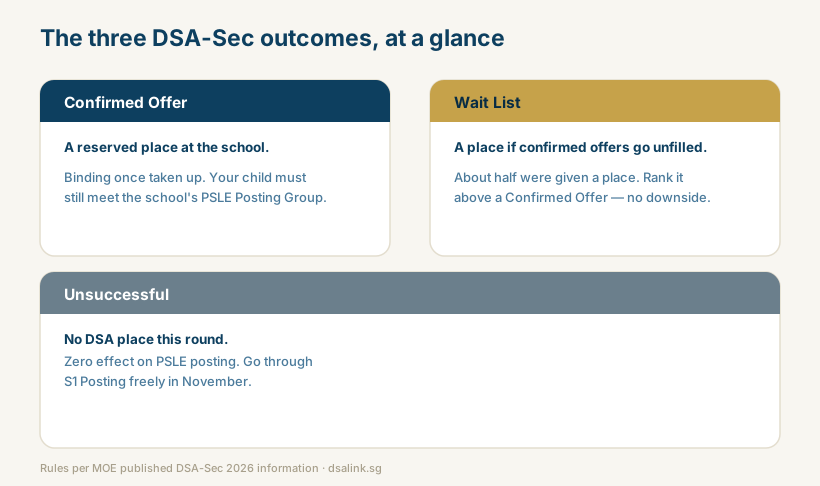
A strong candidate can collect two or even three Confirmed Offers. It feels like winning, and then you remember your child can take up exactly one. Here is the point most parents miss: you can hold several Confirmed Offers right through to October. What you cannot do is accept two. There is no form to sign in August; the single acceptance happens when you rank your schools on the October preference form, and the moment your child is placed in one, the others fall away. So the decision is real, it's yours, and you have weeks to make it well.
The instinct is to rank by prestige and take the "best" name on the list. That's the trap. A DSA place isn't general admission; it's admission into a talent programme, and the school with the biggest name isn't automatically the one that will grow your child's real strength. Work the choice on four questions instead:
- Does this school genuinely resource the talent? A named CCA is not the same as a serious programme with coaches, facilities, competition exposure, and a track record. This matters most for team talents — a sport or an ensemble, where your child is only as supported as the coaching around them. A prestigious school can still be thin in one specific area, and a team that turns up to competition after competition outmatched and outcoached wears a child down; plenty come home in tears from a season that was lost before it started. The offer that looks lesser on paper may be the one that actually grows your child, because the coaching behind it is real.
- Can your child picture themselves there, not on open-house day but on an ordinary Tuesday? Culture and social fit decide whether a talented child thrives or quietly shrinks. A confident performer can still be miserable in a house that runs too intense, or where they don't fit.
- The commute, honestly. A one-hour journey feels fine when you're excited. It feels very different at 6pm after training, three or four times a week, for four years. Map the real week, not the brochure.
- The load after admission. A DSA talent programme runs on ongoing commitments like rehearsals, trainings and competitions, stacked on top of a demanding academic pace. Ask whether that combination is one your child can sustain for years, not just survive for a term.
One more thing to weigh honestly, whatever offer is in front of you: your child's academic footing. A DSA place is won on talent, and it's conditional only on clearing the school's minimum Posting Group, not the sharper PSLE cut-off its mainstream intake usually takes. That is the real advantage of DSA, and it has a quieter flip side: your child may sit in a cohort where many classmates arrived on stronger PSLE results, with the academic pace set to match them. The school, for its part, is investing in that talent and will expect your child to keep training, competing and representing it, not to let the CCA quietly fade. For a child who is comfortable in class, carrying both is demanding but doable. For a child whose studies are already a stretch, a full talent commitment and a faster cohort at the same time can be a real load. It isn't a reason to say no; it's a reason to choose the school where your child can carry both, not the one with the best name on the gate.
A worked example. Picture two offers on the table. One is a brand-name school an hour away that lists your child's sport as one CCA among dozens. The other is a quieter neighbourhood school fifteen minutes from home that has sent athletes to the National School Games finals three years running. On prestige, the first wins easily. On the four questions above, the second often wins: stronger coaching, a real competition pathway, and a journey your child can still stomach in Secondary 3. The "lesser" name can be the stronger DSA place. That is exactly the call the four questions are built to surface.
The test that cuts through all of it: picture your child midway through Secondary 2 — the second year of secondary school, about eighteen months in, once the excitement of the offer has long worn off and the training-plus-homework grind is just their ordinary week. Would they still be glad they chose this school? The right DSA school is the one they'd choose again in the middle of the hard part, not the one that looks best the day the offer lands.
If you have one Confirmed Offer and you're happy with it
The cleanest outcome, and still worth one clear-eyed check, because a Confirmed Offer your child takes up is binding. In MOE's own terms, a DSA student must honour the commitment for the duration of the programme: they cannot submit school choices during S1 Posting, and cannot transfer to another school after PSLE results are released. There is no published exception. That is not a reason to hesitate; it's a reason to be sure before you rank it.
So run that same "Secondary 2" test once. If the answer is yes, take it and stop shopping. The strategic move here is to stop — resist the pull to keep scrolling forum threads comparing your offer to schools your child didn't get. Second-guessing a good, binding offer is how a settled family talks itself into needless anxiety. The offer carries one condition, and it's an important one: your child must still sit the PSLE and meet the school's Posting Group. A Confirmed Offer is not a pass on PSLE — it's a place that unlocks once the academic bar is cleared. PSLE still matters, right to the end.
If you have a lukewarm offer and a wait list at the school you actually wanted
This is the scenario families get wrong the most. Your child has a Confirmed Offer at School B (fine, safe, not the dream) and a Wait List at School A, the one you really wanted. A careful parent's instinct is to protect the sure thing: accept B, let A go, don't risk it.
That instinct costs families the school they wanted, because it misreads the mechanics. You are not trading one for the other. When the October preference window opens (9am Mon 19 Oct to 4:30pm Fri 23 Oct 2026), you rank up to three schools in order, and MOE is explicit that you can put either one first:
- Rank A (Wait List) above B (Confirmed). If a seat opens at A, your child takes it. If none opens, your child still goes to B, because the Confirmed Offer is held regardless of where the wait list lands. There is no version of this where you lose B by trying for A.
- Rank B (Confirmed) above A. Your child goes straight to B, and the Wait List at A never comes into play — confirmed placements are settled before wait lists are ever reached. You've closed the door yourself, for nothing.
Putting the Wait List school above the Confirmed Offer has no downside. Putting it below guarantees the wait can never come through. And the odds are better than the cautious word "wait list" suggests: MOE's published figure is that in previous years, about half of wait-listed students were eventually given a place.
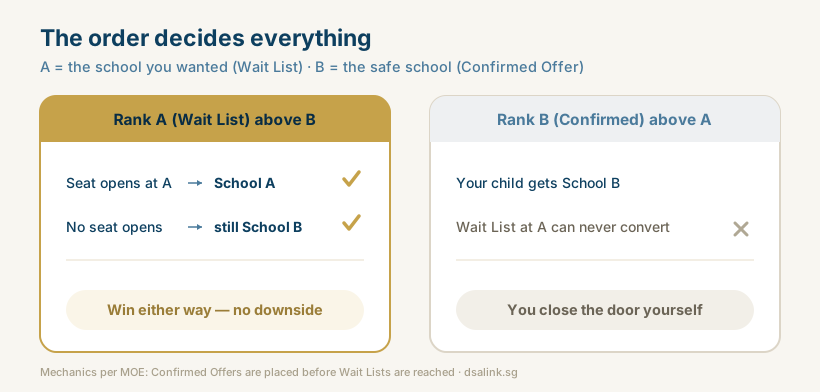
A worked example. A family holds a Confirmed Offer at a solid school near home and a Wait List at the IP school their daughter had set her heart on. Their gut says lock in the sure thing and forget the wait list. Ranked the way the mechanics reward, with the wait-list school first and the confirmed second, she keeps the confirmed place no matter what happens, and still has a live shot at the school she wanted. Ranked the cautious way, she can never get off that wait list. Same two results, opposite endings, decided entirely by the order on one form. We wrote the full version of this one decision, including how to handle the noise from your talent circle, in Your Child Is on a DSA Wait List.
If you have a Wait List and nothing else
No Confirmed Offer to fall back on, just the "maybe", and it's the hardest version to sit with, because there's nothing solid in hand. Picture a child who comes out of results day with two or three wait lists and not a single confirmed offer. It stings, but it is far from a dead end.
The useful thing to know: you don't have to make the Wait List school your first choice to stay in the running. Rank it where it honestly sits in your order of preference, keep the wait alive, and build your real fallback around PSLE and S1 Posting, both fully open in November. Work both sides at once. Give the wait every chance to come through (about half of wait-listed students got a place in past years), and at the same time make sure the school your child would land in through S1 Posting on their PSLE score is one you could accept. A wait list is a live option, not a plan; the plan is PSLE.
If nothing came through: all Unsuccessful
This is the outcome that hurts most, and the one most wrapped in myth: an unsuccessful DSA has zero effect on PSLE posting. Your child enters the S1 Option Form process normally, on their PSLE Achievement Level total, competing on exactly the same footing as everyone who never applied. Nothing about a DSA rejection is recorded against them, shared with other schools, or carried into November. The slate is clean.
And the doors that remain are real ones:
- S1 Posting places your child by PSLE results across the full range of schools, including ones you hadn't seriously considered that turn out to fit well.
- S1 Appeal. After S1 Posting results, you can also appeal to other schools for a transfer; each school runs its own appeal process (per MOE).
- CCA and open trials at the posted school are a genuine second route into the very talent your child was building toward. A school doesn't need to have offered a DSA place for your child to make its team or ensemble.
A worked example. A child trains for years, applies to a handful of schools in their strongest area, and is turned down by every one. To that child it lands as a verdict on their ability. It isn't one. DSA takes only a small number per talent, per school, and being outside that number says little about how good they are and a lot about how few seats there were. Plenty of children rejected across the board go on, through ordinary posting, to a school with a strong programme in their area and end up leading it. A closed DSA door is not a closed door on the talent. It's the honest distinction, and the one your child most needs to hear from you tonight.
If your child applied to a dual-track school (IP and SEC)
Some schools, what MOE calls dual-track schools, run both an Integrated Programme (IP) and a four-year O-Level (SEC) course, so a Confirmed Offer from one of them comes with a track attached. Per MOE's FAQ, you select "No Preference" for the talent area and the school when you apply, and once your child is shortlisted you tell the school, during the selection process, which programme your child would like. The school then decides which track to offer, based on its assessment.
That track is final. Per schools such as Catholic High, in their official reply on ask.gov.sg, a child who accepts a Confirmed Offer for the SEC track cannot move to the IP on the strength of their PSLE score, even if it would have qualified; some dual-track schools open applications to transfer to the IP at the end of Sec 2. The same binding as any Confirmed Offer applies: no S1 Posting choices, no transfer after PSLE. So weigh the track as a real part of the offer. For some families the O-Level track at a school they love beats an IP place somewhere they don't; for others the IP was the whole point. Check the school's own admissions page for how its two tracks differ before you decide. The PSLE gate still applies too: the score must qualify for a Posting Group the school offers, and for the IP, MOE requires 22 or better. If it doesn't, the child is not admitted through DSA and goes through S1 Posting instead. The full mechanics of all three outcomes are set out in the DSA-Sec results guide.
If the offer made you realise you're not sure about DSA at all
Sometimes the offer in hand is what finally clarifies that your family isn't sure about DSA after all — a binding, four-year commitment can look different once it's real. That doubt is allowed, and you have a clean option: you can decline. A child who holds no DSA place goes through S1 Posting in November with complete freedom to choose schools on their PSLE score, and none of the DSA binding attaches, because the binding only attaches once your child takes up a place.
Turning down a good offer to keep your options open is a legitimate strategy, not a waste of the effort that got you here. The one condition is that it's a decision you and your child make together, with clear eyes, not a panic in either direction, and not one parent overruling a child who wanted the place.
The part of the strategy parents skip: steadying your child
Most decision guides leave this out. How your child feels on results day shapes how well the whole family decides. A distraught child, or a parent radiating disappointment, makes every ranking conversation harder. Handling the emotion well isn't the soft part of results day; it's part of the strategy. Child psychologists are fairly consistent on how to do it:
- Don't rush to fix it. Carey Werley, a clinical social worker at the Child Mind Institute, points out that when an outcome can't be changed, the job isn't to repair it but to listen to and acknowledge the disappointment. Reaching straight for "don't worry, it's fine" tells a child their feeling is the problem, and, as the Child Mind Institute warns, brushing off the hurt mostly leaves them feeling more alone with it.
- Validate before you pivot. Creative arts therapist Katherine Prudente, also of the Child Mind Institute, frames the first move as naming the feeling, something as simple as "that's so disappointing, I know how much you wanted this." A child usually needs to feel understood before they can even hear the alternatives, so the comfort has to come before the plan.
- Praise the effort, not the result. Prudente's guidance is to tie a child's worth to character rather than achievement, being proud of how hard they trained and how much courage it took to try, entirely separate from whether the offer came. This is what protects a child from reading a rejection as a verdict on them.
- Let them help solve it. Rather than solving everything for your child, Prudente suggests taking a back seat and letting them take the lead. Bringing them into the ranking decision at their level builds the sense that they still have a say in what happens next.
- Show them you trust them to handle it. Psychologist Madeline Levine, quoted by the Child Mind Institute, suggests messaging along the lines of "I know it's really hard, but I think you can handle this." Said and meant, it does more than reassure; it hands the child a version of themselves that copes.
None of this means hiding your own disappointment behind a fixed smile; children read that instantly. It means letting yourself feel it, letting them feel theirs, then turning together toward the decision in front of you. A child who feels understood on results day is one who can help you make a good choice by October.
The one thread through every outcome
Whatever landed in your inbox, two things stay true. Nothing forces a final choice in August. The offers, wait lists and rankings are all reconciled later, on the October preference form and confirmed with PSLE results in November. And PSLE remains the spine of the whole process: a Confirmed Offer is conditional on meeting the school's Posting Group, a Wait List place depends on it too, and if no DSA place comes through, PSLE and S1 Posting are the main doors, all of them still open.
So whenever your result lands, do less than you think you need to. Read the outcome, steady your child, get clear as a family on what you'd truly choose, and let the real decisions happen on their own timeline.
Quick answers to the questions parents ask on results day
Can my child hold more than one DSA Confirmed Offer? Yes. Your child can hold multiple Confirmed Offers through to October, but can only ever take up one. The single acceptance happens when you rank schools on the School Preference Form; being placed in one school ends the others.
Is a DSA Confirmed Offer binding? Yes. Once your child takes up a DSA place, they must honour it for the duration of the programme: no submitting school choices during S1 Posting, and no transferring to another school after PSLE results. MOE publishes no exception, so be sure before you rank it.
Can I reject or decline a DSA offer? Yes. You can decline, and a child who holds no DSA place goes through S1 Posting in November with full freedom to choose schools on their PSLE score. The binding only applies once your child takes up a place.
When do I have to decide? On the School Preference Form, open 9am Monday 19 October to 4:30pm Friday 23 October 2026. You rank up to three schools that gave your child a Confirmed Offer or a Wait List, in order. That form is the decision — nothing is locked in August.
Does an unsuccessful DSA affect PSLE posting? No. An unsuccessful DSA has zero effect on S1 posting. Your child competes on their PSLE Achievement Level total on exactly the same footing as everyone who never applied. Worried about a diagnosis or exam access arrangements? See what the official rules say.
Can a DSA Wait List become a Confirmed Offer? Not as such: a Wait List doesn't turn into a Confirmed Offer. Wait-listed students are given a place if vacancies remain after confirmed offers are settled, and that outcome is released with PSLE results in late November. In previous years, about half of wait-listed students were eventually given a place. Ranking a Wait List school above a Confirmed Offer carries no downside — you keep the confirmed place if no seat opens.
How does a dual-track school decide between the IP and SEC tracks? A dual-track school runs both an Integrated Programme (IP) and a four-year O-Level (SEC) course. Per MOE, select "No Preference" when you apply and tell the school which programme your child wants once shortlisted; the school decides which track to offer, based on its assessment. Per schools such as Catholic High, the track offered is final: accepting an SEC offer does not let you switch to the IP on your PSLE score, though some dual-track schools open applications to transfer to the IP at the end of Sec 2.
Does my child still need to do well for PSLE after a DSA offer? Yes. Every Confirmed Offer is conditional on your child meeting the school's PSLE Posting Group. A DSA place removes the competition for a seat, not the need to clear the academic bar.
For the full mechanics of all three outcomes, see the DSA-Sec results guide; for the wait list decision in depth, start here.
DSALink is an independent guide for Singapore parents, not affiliated with MOE. Timings and rules above reflect MOE's published information for the 2026 DSA-Sec exercise; always confirm details on the official MOE DSA pages. The family situations described are illustrative composites drawn from common DSA patterns, not real individuals. The guidance on supporting your child draws on published advice from the Child Mind Institute.
Free · No spam
Get DSALink updates
New DSA guides on schools, interview prep and coaches, sent to your inbox from time to time. No spam.
Follow us
Daily DSA tips, school news, and quick guides across: