28 May 2026
What Should Your Child Say at the Open House? (Most Say Nothing Useful)
Most P6 students stand quietly beside their parents while the adults ask all the questions. That's a missed opportunity — here's exactly what your child should say, and to whom.
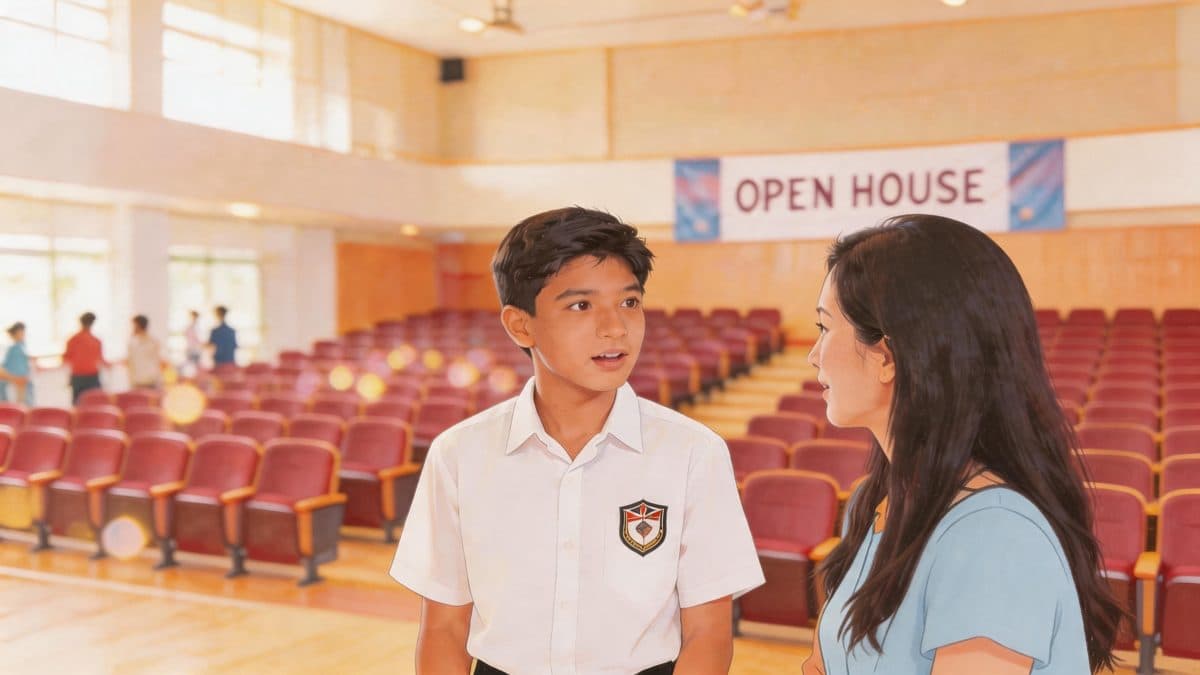
Picture the scene.
The school hall is packed. You've found the CCA booth your child has been talking about for three years. The teacher-in-charge is standing right there, a metre away, clearly available.
Your child says nothing.
You ask all the questions. The teacher answers you. Your child nods. You leave with a brochure.
This happens at almost every open house, to almost every family. And it's a missed opportunity — because at most schools, the teachers at those booths are the same people who will later read your child's DSA application, shortlist candidates, and run the trials.
They notice the students who speak up.
Why this matters more than most parents realise
Open houses are officially for information. Unofficially, they're the first impression.
CCA teachers don't have the bandwidth to remember every face. But they do remember the student who asked a sharp question. Or the kid who demonstrated something right there at the booth. Or the one who said something specific about why they want to be in this programme — not because their parent pushed them forward, but because they walked up and said it themselves.
This doesn't mean your child needs to perform. It means they need to show up in the conversation.
Who your child should talk to (and who they shouldn't)
Talk to: The CCA teacher or coach at the booth. If there are current students volunteering, talk to them too — they'll be more honest.
Don't rely on: The general school information booth. The brochures. The parents standing next to you.
The CCA teacher is the person who matters. That's the conversation worth having.
What to say: a simple script
Your child doesn't need to be impressive. They need to be genuine. Here's a structure that works:
Step 1: Introduce yourself
"Hi, I'm [name], I'm in P6 at [school]. I'm interested in [CCA name]."
That's it. Name, school, what they're there for. Five seconds. Most kids skip this entirely and just hover.
Step 2: Ask one real question
Not a question they can answer by reading the school website. Something specific:
"I've been doing [activity] for [X] years at [club/school]. What level do most students come in at for DSA?"
"I heard your [CCA] trains for [specific competition]. Is that something all members work towards, or mainly the senior team?"
"What's the biggest adjustment students find in the first year here compared to primary school?"
One good question signals more genuine interest than three generic ones.
Step 3: If it feels right — show something
If your child does dance, and the teacher asks about their background, they can offer to demonstrate a short phrase. If they do music, they can mention what piece they're working on. If they do debate, they can speak in full, well-structured sentences (this itself demonstrates something).
This doesn't need to be rehearsed like a performance. It just needs to be natural.
Step 4: Thank them by name
Look at the teacher's name tag. Use their name when saying goodbye.
"Thank you, Mr [name]. This was really helpful."
Small detail. Remembered.
What current students at the booth can tell you
Volunteer students at open houses are usually more candid than teachers. Your child should ask them:
- "What do you wish you knew before you joined?"
- "How do you balance training and studying here?"
- "Is it what you expected?"
These questions get real answers. A teacher will give you the polished version. A Sec 2 student who joined via DSA will tell you the truth.
What your child should NOT do
Don't read from a list of questions. It looks scripted and disconnects the conversation.
Don't let parents speak for them the entire time. This is the child's application. Teachers notice when a student stands silently while parents do all the talking.
Don't pretend to know more than they do. "I've been following your CCA's results online" is fine. "I'm already at national level" when they're not — teachers can usually tell.
Don't rush. If the booth is busy, wait a moment. A 90-second genuine conversation is worth more than a panicked exchange while three other families crowd in.
After the open house: the one thing to do before bed
That same evening, have your child write down — in their own words:
- The teacher's name
- One thing they learned that surprised them
- One thing they want to remember when writing the application
Not because anyone will check it. Because the act of writing it makes it real, and because when they sit down to write their DSA application in a few days, they'll actually have something specific to say.
"I visited the school on 30 May and spoke with [teacher name]. What stood out was..." is a dramatically better opening than "I have always been interested in [CCA]."
This Saturday: three schools to practise this
Cedar Girls', SST, and Yusof Ishak Secondary are holding open houses this Saturday, 30 May.
If your child has been quietly interested in any of them, this weekend is the moment to stop observing and start engaging.
The application window closes in five days.
For school-specific details on what to look for at each open house, see our 30 May Open House Preview. For the parent-side checklist of questions to ask, read what to look for at a DSA open house, and for what each school said on the day, see our 30 May open house recap.
Find out which schools still have open houses coming up — and get reminders before key DSA dates. Subscribe here.
Free · No spam
Get DSALink updates
New DSA guides on schools, interview prep and coaches, sent to your inbox from time to time. No spam.
Follow us
Daily DSA tips, school news, and quick guides across: